A new book by Eric Steele
You’re Not the Bad Guy for Noticing
A family’s guide to the early stage of dementia and Alzheimer’s
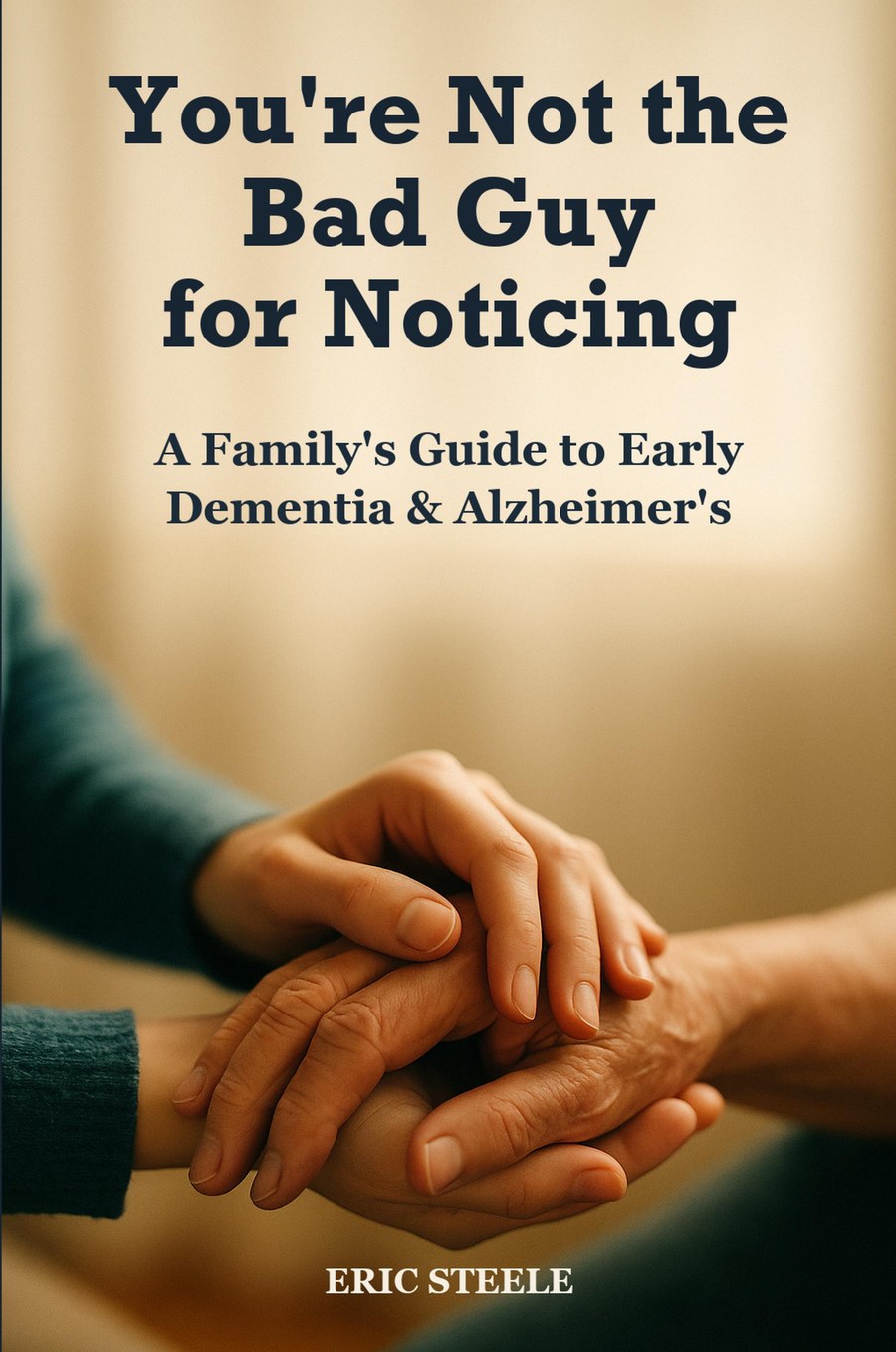
You noticed first. This is about what to do with that — before the window closes.
The repeated question. The bill that didn’t get paid. The wrong turn on a road they’ve driven for thirty years. You noticed — and then, like most families, you waited, because saying it out loud felt like a betrayal, and there was never enough time.
That wasn’t weakness. The closest people almost always see it first and act last, for reasons that are entirely human. But it was time you don’t get back.
This book is about the part of the road no one prepares you for: the early stretch, when it feels too soon to act and it’s quietly becoming too late to wait.
It isn’t stubbornness, and it isn’t disloyalty
When you finally say something and they get angry — insist nothing’s wrong, turn it around on you — that usually isn’t them being difficult. Often it’s the disease itself. The same changes that take the memory can take the ability to see that anything has changed.
It has a name: anosognosia. Depending on how it’s measured and how far along the disease is, estimates run from about a fifth of people with Alzheimer’s to as many as four in five. However it’s counted, it is common — and it is not a choice they are making.
You will not win that argument.
You were never going to.
And the resistance you’re hitting isn’t a rejection of you. Knowing that changes every conversation that comes after it.
Start with the window
There is a window — while your loved one can still sign, still choose who they trust, still say what they want — and it closes quietly. Most families don’t know it’s there until it has already shut.
On the near side of it, the decisions get made gently, at a kitchen table, with the person themselves in the room. On the far side, those same decisions move to a court, on a slower and far more expensive timeline, made by people who never knew them. The difference between the two is a handful of documents signed while there was still time — the durable power of attorney, the healthcare proxy, the wishes written down.
The window is open right now. The steps to protect it are simple, if someone tells you what they are. That is a large part of what this book is.
A book about acting in time, not about medicine
I’m not a doctor or a lawyer. I’m someone who has watched this move through the families around me for years — my wife’s family, friends’ parents, people close enough that I saw it up close, more than once. What stayed with me wasn’t only the illness. It was the helplessness on the faces of the people trying to help: the guilt, the frustration, the sense of being handed something enormous with no instructions.
So I wrote the plain-spoken guide I kept wishing someone had handed them sooner. It comes down to the two things almost every family gets wrong — not from neglect, but because no one ever told them: seeing it clearly and in time, and protecting what matters while your loved one can still take part in their own decisions. Everything else in the book serves those two.
Seventeen chapters, in four parts
Part One — Seeing It Clearly
- 1The Hardest Part Is the Beginning
- 2Is It Time? Normal Aging, Warning Signs, and the Myth of “Too Soon”
- 3Why They Can’t See What You See
- 4How to Talk About It Without Becoming the Enemy
- 5Getting Them to the Doctor
- 6When They Say No
- 7The Window Nobody Warns You About
- 8The Documents That Depend on Capacity
- 9Gathering What Matters: The Gentle Inventory
- 10The Money and the Clock
- 11Keeping Them Safe
- 12When It Gets Hard: Reactions and How to Respond
- 13What to Expect as Things Change
- 14Bringing the Family Together
- 15Getting Help: Paid Care, Respite, and When You Can’t Do It Alone
- 16Taking Care of You
- 17Where to Find Real Help
Parts Two, Three and Four are The Conversation, The Window, and Living It. Plus pull-out tools built to be used rather than read: a warning-signs guide, questions to bring to the doctor, a first-30-days checklist, word-for-word scripts for the conversations that are hardest to start, a de-escalation cheat sheet, and a caregiver’s bill of rights.
How this book was made
AI was used in making this book — the cover, and in drafting the text. I’d rather say that plainly than have you find it out.
What isn’t machine-made is the experience it comes from, or the judgment on every page. It’s grounded in the current, publicly available understanding of the disease as of 2026 — and because medicine moves fast and every family is different, it is a starting point, not a substitute for a real conversation with a doctor, an attorney, or the Alzheimer’s Association. The same standard applies to everything published under this name, and it’s explained in full here.
What it doesn’t promise
This book will not cure anything, and it will not make this easy. There is no version of this that doesn’t hurt, and no new person waiting at the end of it.
What it offers is smaller, and real: that you act in time instead of too late, that you act gently instead of in a fight, that your loved one’s wishes are honoured while they can still voice them — and that when the harder days come, your family is ready instead of scrambling. And one thing more, the thing the title is about: the quiet permission to stop feeling like the villain for being the one who noticed.
You don’t have to do it all today. You just have to start.
You’re Not the Bad Guy for Noticing
83 pages. Paperback and Kindle, on Amazon.
View on AmazonAI was used in making this book, for the cover and in the text. The experience and the judgment are mine. Full explanation here.
The companion tool
The Family Inventory
Chapter nine is about gathering what matters — the documents, the accounts, the digital life, the wishes. This is the thing you gather it into.
Every account, all the property, health and wishes, with a natural conversation opener for each section so you’re reminiscing rather than interrogating. And a safe way to handle logins: you never write a password into it, only where the password is kept.
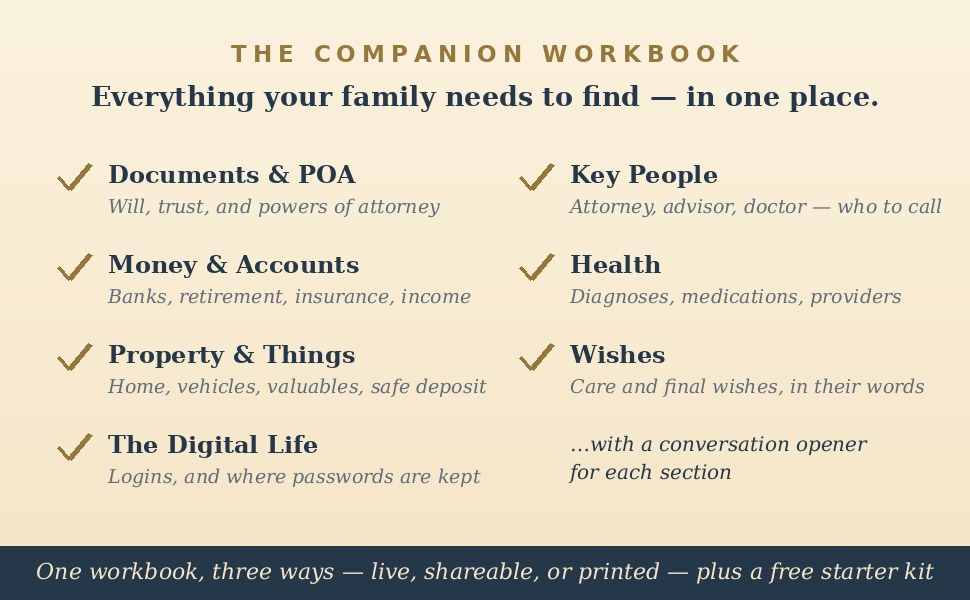
- Live version — a Google Sheet you update from your phone
- Shareable version — a Google Doc for the whole family
- Print and write — a PDF for the kitchen drawer
$12.99 — all three formats. Same price as the paperback.
Get the workbookNot ready for that? A first-30-days checklist and a starter inventory sheet are free, with no catch. Get the free starter kit
Eric Steele also publishes It Doesn’t Go There, and the Residential Lines and Landmark Lines architectural books, drawn to be coloured.