A new book by Eric Steele
It Doesn’t Go There
How to declutter your home and keep it from filling back up
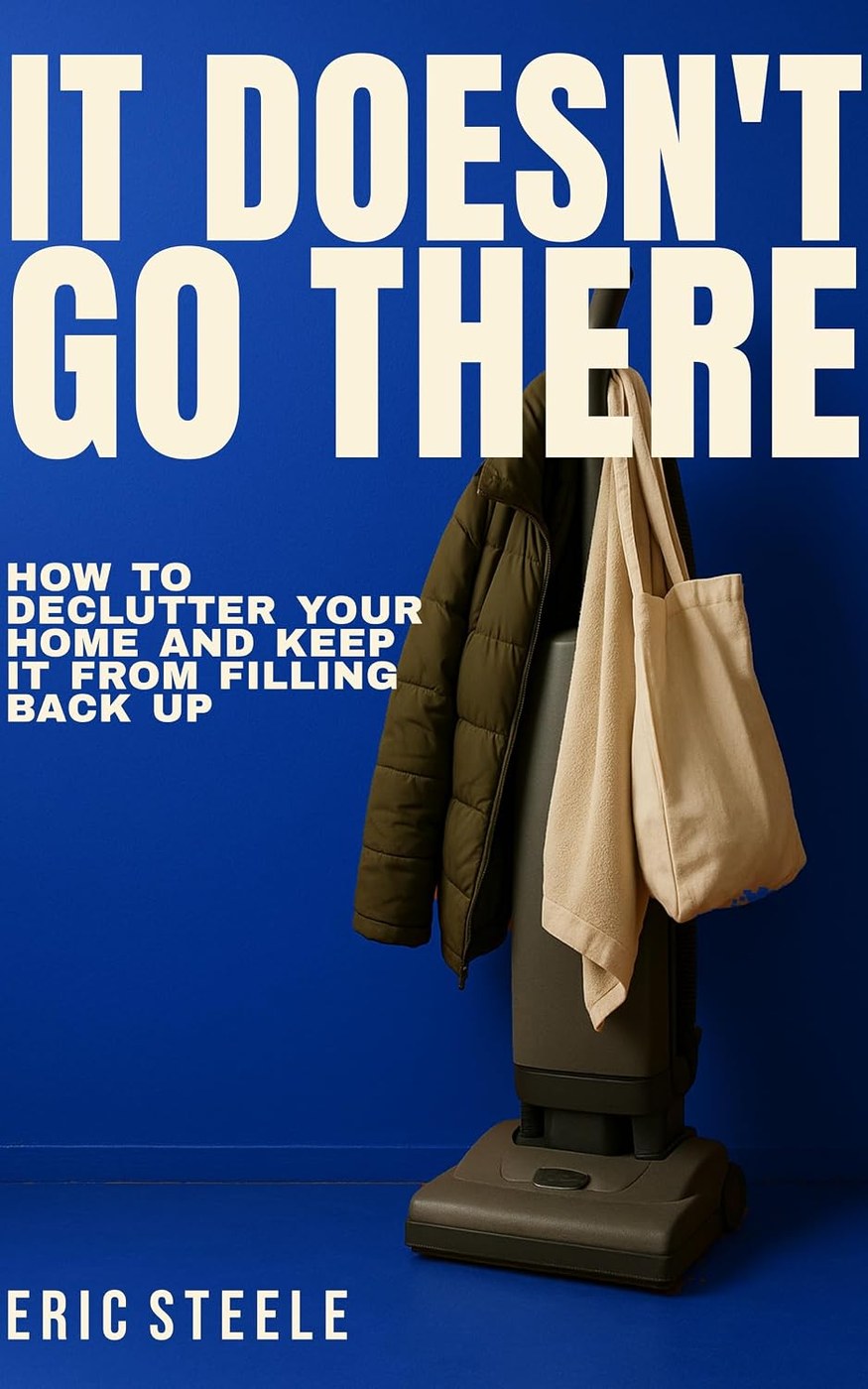
You have decluttered before. This is about why it came back.
You had the Saturday. Bags by the door, counters clear, a real feeling that this time it holds. Then Tuesday there are two things on the kitchen counter, and three weeks later most of it is back, and you couldn’t name the day it happened.
That isn’t a discipline problem. A purge removes what accumulated. It doesn’t change what happens tomorrow. The mail still comes, the deliveries still arrive, and you still walk in holding four things and needing a hand free.
So effort was never the missing ingredient. You already supplied effort, and the surface is covered again.
Start with the drains
Count the drains in your house. Kitchen sink, bathroom sinks, the shower, the tub, the toilets. One in the laundry, probably one in the garage floor. Outside there’s a yard drain, and gutters, and something at the bottom of the driveway. Fifteen or twenty openings, most of which you couldn’t point to from memory.
Every one of them works, and you have never once maintained them.
A drain doesn’t clog from neglect — there’s nothing to neglect. It clogs from use. From a small wrong choice made over and over, each time so minor that calling it a choice feels dramatic. Grease down the sink once is nothing. And the correct version costs nothing either.
Now think about the surface by your door. It has the same physics.
Every object in your hand is a question.
Answer it once, and it never asks again.
A book about design, not willpower
The method comes down to one rule: every object has a there. You decide it the first time the thing is in your hand, and then it goes there or it goes out. It never just goes down.
I spent twenty years designing and building retail interiors and trade show exhibits — work that comes down to deciding where things go so people can find them and use them. That’s the whole of what this book is. Not a character fix. A design problem, solved the way you’d solve one in a building.
Twenty-five chapters
- 1The Drain
- 2It’s Not Laziness
- 3What Your Stuff Is Charging You
- 4Why the Pile Grows When You’re Tired
- 5The Tidy House That Still Exhausts You
- 6It Doesn’t Go There
- 7In Your Hand
- 8The Four Destinations
- 9Where Things Live
- 10The Decisions You’re Making Twice
- 11Why You Stall on Day Eight
- 12The Settle
- 13The Evening Pass
- 14The Morning Pass
- 15What a Missed Day Costs
- 16The Recovery Protocol
- 17High-Traffic Surfaces
- 18The Weekly Reconciliation
- 19You Are the Single Point of Decision
- 20Giving Kids Their Own Ledger
- 21The Partner Problem
- 22The Things Nobody Owns
- 23Stopping the Inflow
- 24The First Week
- 25What Changes
How this book was made
AI was used in making this book — the cover art, and in writing the text. I’d rather say that plainly than have you find it out.
What isn’t machine-made is the method. Twenty years of deciding where things go so people can find them is where this came from, and every page went past that before it stayed. The same standard applies to the architectural books, and it’s explained in full here.
What it doesn’t promise
Your house is not going to look like a photograph. There is no transformation here, and no new person at the end of it. What there is: a home that stops refilling, and the attention that comes back when it does.
Start tonight, with the surface by your door.
It Doesn’t Go There
160 pages, paperback. Available on Amazon.
View on AmazonAI was used in making this book, for the cover and in the text. The method and the judgment are mine. Full explanation here.
Eric Steele also publishes Residential Lines and Landmark Lines — hardcover architectural books, drawn to be colored.